MODULE THIRTEEN: 4/21-4/27: Civil Rights Movement & The 1960s: Vietnam and Social Movements
Section outline
-
CIVIL RIGHTS MOVEMENT:
As our society wrestled with the new gender and queer movement that emerges at the end of World War II, the younger generation takes up the call for action. As we have seen in our current moment, the younger generations are those who are most likely to put their lives on the line in direct protest for social justice. We know that part of this phenomenon comes from the fact that younger people are less likely to have the same responsibilities of those who are married with children and homes. This affords the younger generation a certain amount of freedom to engage. Also, the younger generation is the one most likely to express discontent with the current social, political, and economic realities.
The modern African American civil rights movement emerges in this era of discontent. You all know of Martin Luther King, Jr. Many of you recently became familiar with John Lewis, who was a leader in the Student Nonviolent Coordinating Committee. This group of college students risked their lives in King and SCLC faltered during the Freedom Rides. The Birmingham Campaign brought images of children being sprayed by fire hoses that were strong enough to rip flesh. It was the images of children being attacked by police dogs and fire hoses that made their way into American homes across the nation. (This ties to our earlier conversations on Industrialism. After all, our consumerism led us all to buy the televisions that became the medium for raising awareness of racial injustice in the South.)
THE 1960s:
The 1960s were a tumultuous time that was informed by the rise of the middle class in the 1950s and the discontent of the baby boom generation coming of age. This was an age of social movements. But the country was set for more than just one voice of discontent. The struggle for equal access to political rights, protections of law, employment opportunities, and division between the generations led to massive waves of protest across the country. I suppose you may be able to identify with these earlier moments at this time...
We also come to the Vietnam War. Cold War politics lead to U.S. intervention into the split between northern and southern Vietnam. Mistrust in the ongoing warfare, the draft, and a counter-culture of drug use led to protests from within and outside of active troops. Between 1966 and 1973, more than 500,000 U.S. military personnel deserted.HINT: Watching the videos in the PPTs will help you with the discussions.
-
-
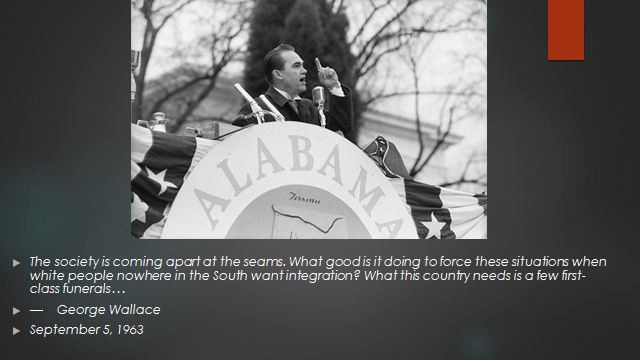
What does it matter if our politicians express racist dog whistles and call for violence?
On September 5, 1963, Governor George Wallace made the following statement... ten days later, the KKK bombed the 16th Street Baptist Church where civil rights leaders had organized the Birmingham protests.
-
-